
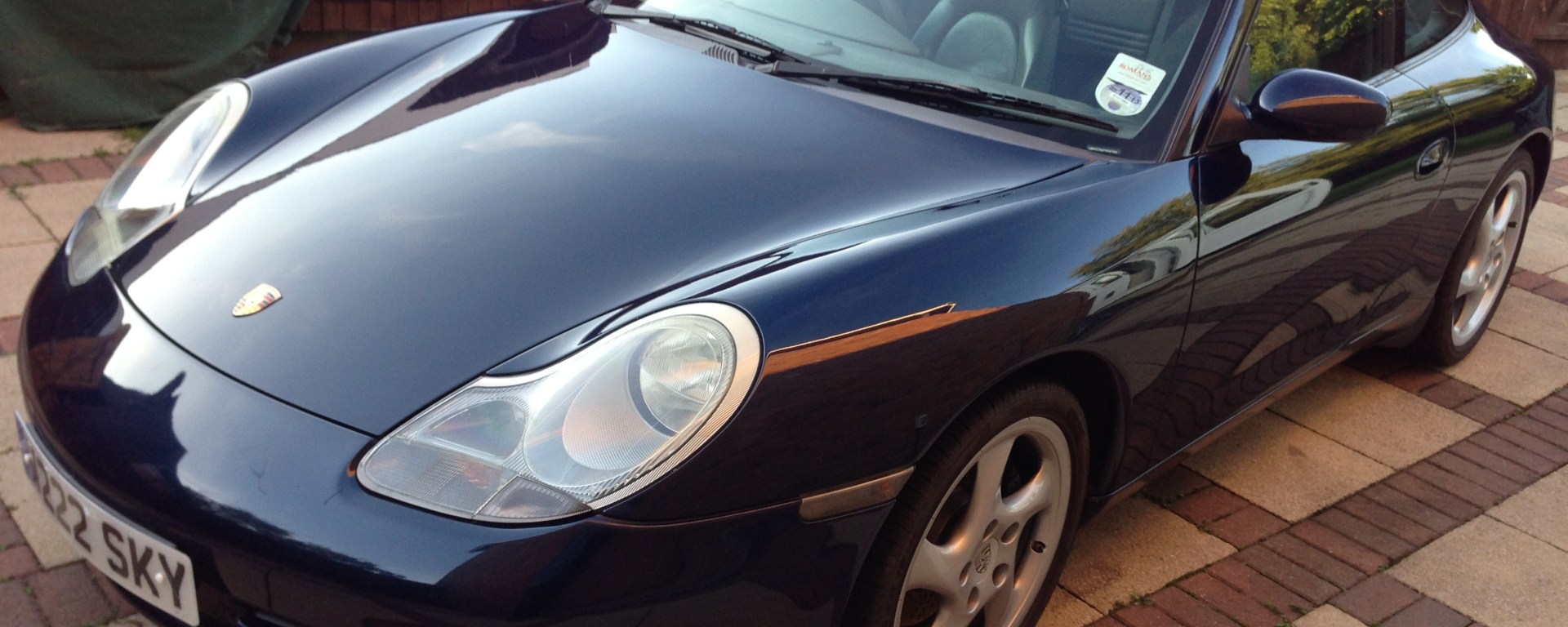
It’s fair to say when buying a new car I do a fair amount of research. Many nights are spent with an iPad in one hand and a beer in the other whilst making sure I’m armed with enough information to avoid a lemon and find the best possible example of what I’m looking for.
In recent years the process of researching a new car has become far simpler and dare I say, more enjoyable. With an array of online resources, such as pistonheads, evo, owners’ forums and YouTube videos it’s never been easier to become a fountain of knowledge in just a few hours and a corresponding number of beers. However, when I came to research Porsche 911’s (996) my experience couldn’t have been more different.
It is without a doubt the most stressful and difficult car to research. Let me demonstrate with a comparison. An Audi RS 4 (B7) and the Porsche. Things to look out for on the Audi asside routine maintenance; the fancy DRC suspension will leak (£1.5k to replace), oil cooler pipes might corrode, it will need a carbon clean (all in about £1k). All relatively expensive, but straightforward ‘known’ stuff. Porsche 996; the IMS or RMS will definitely / probably / might / might-not / definitely-won’t fail (£10k-£15k, or more if you need to replace the engine). Everything else is pretty straight forwards, however each buyer’s guide varies wildly as to the likelihood of these potential issues… That said, the cost to resolve the issue is reassuringly consistent – either £1k as preventative maintenance or a new engine for around £15k.
So what are ‘IMS’ and ‘RMS’?
IMS = Intermediate Main Shaft, technically it is used to transmit power from the crankshaft to the camshaft. In reality it is a poorly designed part in the engine that without warning can crap itself resulting in a rather expensive bill for an engine rebuild, if you’re lucky. If you’re not you’ll need a new engine.
RMS = Rear Main Seal, a seal somewhere in the engine which is designed not to leak oil. Unfortunately it may leak, sometimes with a small drip, however other times it will empty itself onto your driveway, the road etc. Again the likelihood of failures vary but almost all of those that do are expensive.
Can anything else go wrong?
Yes, of course it can. There were reports of the affectionately named ‘chunking’ on the earlier 3.4 litre engine – which also means you’ll need a new engine. The later 3.6 litre engine was not without problems either, as well as sharing the same IMS / RMS timebomb it could also develop bore scoring, which doesn’t necessarily result in a new engine but is still very undesirable and quite costly to fix.
So being none the wiser, and certainly not having the level of expertise, or confidence I would have liked, I started browsing Autotrader mindful that I might need to sell a kidney, or my first born child, to replace my prospective Porsche’s engine. My requirements were simple; a manual coupe and as new and low mileage as I could afford. Armed with my requirements and my newly acquired knowledge I bought the first Porsche 996 I could find, after a 5 mile test drive in the rain. Although it was an early 3.4 litre car, and had covered the best part of 140k, reassuringly it did have its IMS bearing replaced with a later, upgraded version.
There are some other things worth checking – the condition of the brakes, they’re expensive to replace (£1.5k). Tyres are expensive too, so it’s a bonus if they’ve got lots of tread. It’s also worth checking the brand, as if they’re not original spec premium brand then walk away – it’s a good sign of an unloved car. Colours and options are a personal taste but there are some pretty horrific combinations available, one example I saw online was red outside with a ‘full’ red interior, which included seats, dashboard and just about every possible surface. Personally I like subtle so wanted a dark blue, grey, silver or black with a grey or black interior.
So there you go. Fancy a ‘cheap’ 911? Find the best one you can, in a colour combination you like, buy it, enjoy it and hope that the IMS or RMS don’t fail!
 Petrol Dad